

When you step through the gothic revival gates of Green-Wood Cemetery in Brooklyn, you enter a cemetery from times past. This nature preserve is suspended in a bustling city and was one of the first park-like cemeteries in America. Founded in 1838, Green-Wood boasts an impressive 478-acre sprawl of paths, hills, ponds, and sculptures. It was one of the late 19th century’s most viewed tourist attractions in the United States, second only to Niagara Falls. In 2006, the entire cemetery was made a National Historic Landmark.


Green-Wood was designed during a movement toward rural cemeteries. Churchyards were running out of space for burials, and by moving the cemetery outside of town, they could provide vast space for additional graves. The idea was slow to catch on at first.To attract attention the owners contacted the son of the late Senator Dewitt Clinton, and asked if his remains could be honorably reinterred at Green-Wood and his son agreed. Clinton was a well-known and respected figure, and Green-Wood instantly became the most desirable burial place. Today, more than 570,000 people are buried at Green-Wood. Many of them are prominent figures in the history of New York. Through its serenity, cultivation of art, design, and history, Green-Wood Cemetery continues to leave a lasting impact on the living, in addition to memorializing the deceased.
There are so many interesting headstones, sculptures, and stories in this cemetery. That makes it difficult to choose a few to highlight. If you’d like to see a list of famous memorials in this cemetery, click here.


Before visiting the cemetery, check out the hours, rules, and best practices on Green-wood’s website. Due to the cemetery’s expanse and hilly landscape, you might want to consider a guided trolley tour to view interesting graves and sculptures. Tour guides point out significant graves in a unique way. For example, one guide encouraged guests to snap their fingers as she broke out singing, “Cool” from West Side Story while they were visiting the grave of critically acclaimed composer Leonard Bernstein. He wrote West Side Story and many other masterful musical achievements.


This detailed monument is for John Matthews, also known as the “Soda Fountain King.” It was designed by Karl Muller and cost $30,000 in 1870! Matthews invented the soda fountain for carbonated drinks. He also invented a method to bottle carbonated soda. The base of his monument has a sculpture of Matthews himself, life-sized and shrouded. Above him are three carved scenes representing significant moments in his career. On the sculpture platform is a grieving woman, as well as smaller marble sculptures depicting his children. The monument includes other ornamental elements and winged gargoyles that serve as guards. Each corner has a waterspout for rainwater. This is a must-see monument!
Another amazing sculpture is found on the grave of Charles Valentine. The appropriately named Valentine Angel is sculpted by Adolfo Apolloni and invokes a feeling of movement and flight. The angel’s feathery wings and the flowing gown are beautiful.


Next on our tour is the grave of the young Charlotte Canda. Charlotte was an artistic teenager and in the process of designing a monument for her recently deceased aunt when she passed away on her 17th birthday. Charlotte was traveling home from her birthday party in stormy weather when her horses bolted. Charlotte was thrown from the carriage and died later that evening. The family used the monument design Charlotte was creating for her aunt and added additional things that Charlotte loved, such as parrots, books, musical instruments, and artists’ tools. There is also a portrait statue of Charlotte, protected underneath the highly decorated niche, with 17 roses carved around her head – one to represent each year of her young life.


The monument was built by John Frazee and Robert Launitz. Its inscription reads:
She sinks from sight, Eve’s golden star.
Lost in the watery depths afar,
Yet still does the fair planet burn;
Not hopeless is our Charlotte’s urn.
In God’s own more her orb will rise-
Once more a star of paradise.
The beautiful chapel within Green-Wood was designed in 1913 by Warren and Wetmore, the same firm that designed Grand Central Station. The chapel can be rented for small events. Recently historians discovered that the upper dome of the chapel is covered in Guastavino tile. This was an exciting find for the cemetery! There are more than 700 mausoleums at Green-Wood. Many are set amidst glacier ponds or built into hillsides. Every turn reveals another fascinating structure. Green-Wood also has tombs and catacombs, though the catacombs are usually locked.


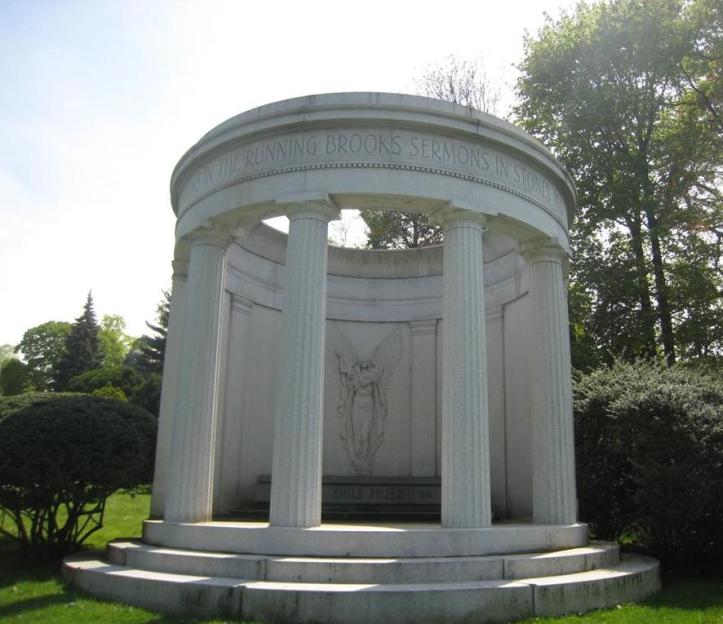
As we round the edge of one of the ponds, we see a monument that belongs to Emile Pzifer, son of Charles Pfizer, who co-founded the Pfizer pharmaceutical company. This monument is designed like a Greek tholos temple and is open to the sky. The lettering above the monument reads TONGUES IN TREES BOOKS IN THE RUNNING BROOKS SERMONS IN STONES AND GOOD IN EVERYTHING, a quote from Shakespeare’s, As You Like It. Emile’s granite sarcophagus lies beneath the winged angel who is gesturing upwards.



James Weldon Johnson, a composer, social reformer, and US Diplomat, is best known for writing the poem Lift Every Voice and Sing, which was set to music by his brother, J. Rosamond Johnson. The hymn was introduced at an event to mark Abraham Lincoln’s birthday in the year 1900. It has been adopted by the NAACP as the Black National Anthem. The hymn speaks of freedom, transcending difficulties and meeting the future with courage and faith. This hymn is well known and included in many hymnals.


William Augustus Spencer was born into a wealthy family with multiple homes abroad. Spencer and his wife, Marie, were aboard the RMS Titanic when the ship sank in April 1912. William died as the ship went down and his body was never recovered. Marie made it into a lifeboat and survived.
William’s cenotaph marker lies in the Spencer family plot. The inscription reads, “Bravely met death at sea in the Titanic Disaster.” It also contains the phrase, “Where Manhood Perished Not.” This phrase comes from a poem written by Harvey F. Thew shortly after the Titanic disaster.
A few years earlier, when Spencer first saw the newly built New York Public Library, he proclaimed that he would donate his collection of finely illustrated and bound French books to the impressive library. When the details of his estate were made public, the library learned that he made good on his word. He also donated a substantial sum of money. In his will, he also directed that after the death of his wife, one-half of his estate was to be “invested as a separate fund, the income of which was to be used for the purchase of handsomely illustrated books.” Today, the Spencer Collection includes an incredible collection of finely illustrated books, fine bindings, and illuminated manuscripts, all thanks to William Spencer’s generosity.
Part of Green-Wood lies on the site of the Revolutionary War battle, the Battle of Brooklyn. The battle took place on the slopes of Battle Hill and resulted in a British victory. It was near this same ground where George Washington’s army, finding themselves surrounded, managed to escape during the night and cross the river to Manhattan. This retreat likely saved the Continental Army.
Charles Higgins was a history buff and wanted to commemorate the Battle of Brooklyn on the land where it was fought. He bought large family burial plots on Battle Hill, which happens to be the highest point in Brooklyn. He also bought the plots in front of his own as the site for a future commemorative monument. After much planning, a sculpture was unveiled on August 27, 1920, on the 144th anniversary of the Battle of Brooklyn. It is a bronze statue of Minerva, the Roman goddess of wisdom, alongside an altar called the Altar to Liberty. She’s placing a laurel wreath on the altar while her other arm raises in salute. Following her gaze and salute, 3.5 miles to the west, is the Statue of Liberty, raising her torch, enlightening the path to liberty in response.


Green-Wood Cemetery received arboretum accreditation in 2015 and has over 7,000 trees located within its grounds! It’s also a bird watcher’s paradise, so be sure to look up when you enter. Right above the front gates, you can see nests of Monk Parakeets, but you’ll probably hear them first! These blue-green parakeets are native to the mountainous regions of Argentina and no one knows how they arrived at Green-Wood, but they have flourished. Legend has it that in the 1960s, a cage broke open at JFK airport and they were released. They couldn’t have found a more serene location to call home.
A visit to Green-Wood is a must for anyone that loves history, art, and nature. It revives the living and memorializes the deceased. Plan a visit to Green-Wood today. Enjoy a trolley tour, stroll through the grounds, and discover something new each time. We hope to see you there!